Tropical Floral Sea Turtle PNG SVG EPS
First Impressions: A Lush, Balanced, and Surprisingly Versatile Mood
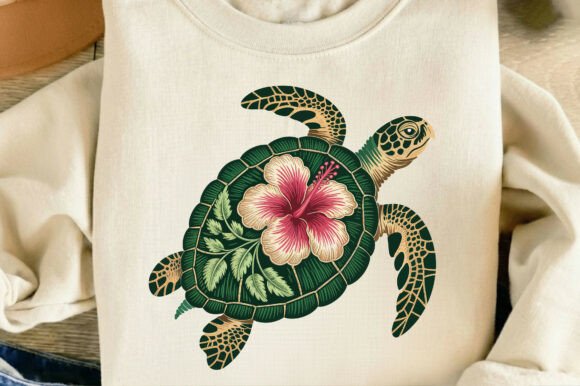
When I opened Tropical Floral Sea Turtle Png Svg Eps, I wasn’t expecting the quiet confidence it carries. It’s not loud or cartoonish—it’s a composed fusion: a graceful sea turtle centered like a medallion, wrapped in soft, flowing florals—hibiscus, fronds, maybe a hint of plumeria—that breathe movement without clutter. The layout feels intentional, not crowded; the negative space around the turtle’s shell gives breathing room for stitching, and the floral tendrils taper naturally rather than ending abruptly. That matters. In embroidery, abrupt ends become loose threads or skipped stitches. This design leans into organic rhythm—not rigid symmetry—which makes it feel handmade even before it’s stitched.
A Real Project Test: Embroidering a Linen Tote Bag for a Coastal Boutique
Last week, I prepped Tropical Floral Sea Turtle Png Svg Eps for a custom linen tote bag order from a small coastal boutique. They wanted something that felt vacation-ready but refined—no cliché palm trees or neon flamingos. This design delivered. On natural linen, the turtle’s curves translated beautifully in satin stitch, and the floral outlines held definition without overloading the fabric. I used a medium-weight cutaway stabilizer (essential for linen’s slight give), and the fill stitch density stayed clean—no puckering, no thread nesting. What stood out was how the design scaled: at 4.5" wide, the details remained legible; at 6", the florals bloomed without turning muddy. That scalability is gold for craft businesses juggling baby onesies, adult sweatshirts, and kitchen towels—all under one cohesive brand language.
Where It Shines—and Where to Pause
Tropical Floral Sea Turtle Png Svg Eps excels on stable, medium-weight fabrics: cotton twill aprons, canvas tote bags, brushed cotton sweatshirts, and structured pillow covers. It reads clearly as a machine embroidery design on light-to-mid-tone backgrounds—especially when paired with muted thread colors like seafoam, terracotta, or warm sand. As an applique design? Absolutely viable—the central turtle shape offers a strong base for fabric layering, and the floral elements provide gentle contrast without demanding tiny, fussy cuts.
But here’s where attention is needed: avoid using it full-size on highly textured fabrics (like bouclé knit or heavy terry cloth) without testing stitch density first. On thin or stretchy fabrics—think baby bodysuits or lightweight tees—scale down to 3.5" or less, and reinforce with tear-away + topping. Curved surfaces like caps require repositioning the turtle’s orientation so the shell stays flat in the hoop; those delicate floral tips near the edges can distort if hooped too tightly. And on dark fabric? Run a black-and-white mockup first—the fine inner lines of the turtle’s flippers and floral stamens may need slight thickening in your embroidery software to ensure visibility after stitching.
What It Adds to Your Finished Product—Beyond Just Looks
This isn’t just a pretty graphic. Used thoughtfully, Tropical Floral Sea Turtle Png Svg Eps elevates perceived value. Customers notice craftsmanship in how well the florals flow *around* the turtle—not just stacked on top. That signals intentionality, which builds trust—especially for Etsy sellers offering personalized gifts or boutique owners curating holiday embroidery collections. On a baby blanket, it reads as soothing and nature-connected; on a chef’s apron, it adds subtle personality without compromising professionalism. For craft fairs, it stands out because it avoids trend fatigue—it’s tropical, yes, but grounded in botanical realism, not Instagram gimmicks.
It also supports brand consistency across product types. Use the same design on a tea towel (with simplified fill stitch), a patch (clean satin outline + minimal fill), and a sweatshirt (full detail, slightly denser), and customers recognize your aesthetic instantly—even without a logo. That cohesion matters for small shop products aiming for repeat buyers.
Practical Embroidery Designer Notes Before You Stitch
- Always test on scrap fabric first—especially if pairing with a new stabilizer or thread brand. Linen and cotton behave differently than polyester blends.
- Review stitch density in your embroidery software. If the file includes dense fill areas near the turtle’s shell, consider reducing density by 5–10% for breathable fabrics.
- Confirm hoop size compatibility. The design’s width suggests it fits comfortably in a 5x7 hoop at standard scale—but verify before digitizing or auto-hooping.
- Inspect small details like the floral centers and turtle eye. If they’re under 1mm in the vector file, they may vanish in stitching—adjust or omit for baby items or high-wash products.
- Test thread color contrast on both light and dark fabric swatches. Some floral greens read beautifully on cream but disappear on navy unless you boost saturation.
- Use proper stabilizer: cutaway for knits and stretchy fabrics, tear-away for stable wovens, and topping for napped or textured surfaces.
- Check licensing terms before selling finished embroidered items commercially—or reselling the digital embroidery file itself. The product listing notes it’s a Graphics asset for T-Shirt Designs, but commercial embroidery rights aren’t explicitly defined here.
Final Thought: A Design That Works Quietly, Not Loudly
Tropical Floral Sea Turtle Png Svg Eps won’t shout from a shelf—but it’ll make people pause, touch the fabric, and ask, “Where did you get this?” That’s the mark of a truly functional embroidery design. It bridges aesthetics and execution: detailed enough to feel special, restrained enough to stitch reliably, and versatile enough to live across baby embroidery, holiday embroidery, custom apparel, and boutique branding. For makers who value clarity over clutter and craftsmanship over convenience, it’s a quietly confident choice—one that earns its place in your design assets library, not just your cart.