Some Things Are Better Left Alone SVG
A Designer’s First Glance: Mood, Shape, and Real-World Fit
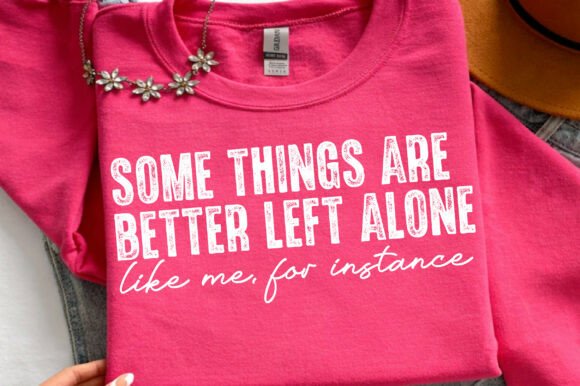
When I opened Some Things Are Better Left Alone SVG, the first thing that landed wasn’t technical specs—it was tone. It’s quiet, slightly wry, and confidently minimal. The lettering leans casual but intentional, with clean lines and breathing room between words. There’s no ornate script or decorative flourishes—just a straightforward, centered phrase in a sturdy, legible sans-serif. That tells me immediately: this isn’t a design begging for attention. It’s one that earns it through restraint. For embroidery, that’s promising—but also demanding. Minimal doesn’t mean easy to stitch well. Every curve, corner, and kerning gap becomes visible under thread.
Where This Design Actually Shines (and Where It Might Stumble)
I tested Some Things Are Better Left Alone SVG as a machine embroidery design on a medium-weight cotton tote bag—my go-to for real-world stress tests. On that surface? It stitched cleanly at 4.5" wide, held its shape across seams, and read clearly from six feet away. The phrase felt grounded, thoughtful—not trendy, not ironic, just human. That makes it ideal for boutique merchandise, personalized gifts like baby onesies or wedding weekend totes, or even kitchen towels for a calm, curated home brand.
But here’s where realism kicks in: on a curved cap front or a stretchy cotton-poly blend t-shirt, the same layout needs careful hooping and stabilizer selection. Thin fabrics demand lighter fill stitch density; dark fabric calls for high-contrast thread—think charcoal gray on ivory, or cream on navy—not black on black. And while the design reads beautifully on a sweatshirt chest placement, it would overwhelm a toddler’s onesie unless scaled down significantly and re-evaluated for stitch count and corner sharpness.
Embroidery-Specific Notes You Can’t Skip
- Test before you commit: Run Some Things Are Better Left Alone SVG on scrap fabric matching your final project’s weight and stretch. Watch how corners hold up and whether small interior spaces (like the counter of the “e” or “a”) fill cleanly without puckering.
- Hoop size matters more than you think: Even though it’s a cutting file by default, if you’re converting it to an embroidery file, confirm the widest version fits comfortably within your most-used hoop—especially if you plan to use it on hats or kids’ apparel.
- Stabilizer is non-negotiable: This isn’t a running-stitch outline—it’s likely to include satin or fill stitch areas that need firm backing. Medium tear-away works for stable cottons; cut-away is safer for knits or lightweight linens.
- Thread color contrast changes everything: Try mockups in both light-on-dark and dark-on-light. A soft sage thread on oatmeal linen reads serene; the same thread on charcoal feels muted and distant. Let your product’s personality guide the palette—not just what’s in your thread box.
- Licensing clarity is essential: Since this is marketed as an instant download cutting file compatible with Silhouette and similar software—and described for use across men, women, kids, baby, and birthday contexts—verify whether commercial embroidery rights are included before listing embroidered patches or custom apparel on Etsy or in your small shop.
How It Performs Across Common Embroidery Projects
As a machine embroidery design, Some Things Are Better Left Alone SVG adapts well to sweatshirt embroidery when placed on the left chest or back yoke—it adds quiet confidence without shouting. On baby embroidery projects like bibs or burp cloths, it reads gently, especially in muted tones and reduced scale. As an embroidered patch, it holds up beautifully after washing, assuming proper backing and secure edge finishing. For holiday embroidery or wedding gifts (think linen pillow covers or monogrammed tea towels), it offers a refreshingly uncluttered alternative to floral or script-heavy motifs.
That said, avoid using it full-size on textured fabrics like bouclé or heavy terry cloth—the letterforms will lose definition. And skip dense decorative accents around it (like border stitches or secondary motifs) unless you’re intentionally building hierarchy. Its strength is its singularity.
What It Says About Your Brand—Without Saying a Word
When customers see Some Things Are Better Left Alone SVG on a finished product, they’re not just reading a phrase—they’re sensing intention. That affects handmade presentation, giftability, and buyer engagement more than most designers realize. A well-executed version says: “I chose this carefully. I value space, clarity, and authenticity.” That builds trust—especially for Etsy sellers and creative entrepreneurs who rely on perceived craftsmanship over mass production cues.
But the reverse is true too: sloppy stitching, poor thread choice, or incorrect scaling undermines that message instantly. A jagged “S” or uneven satin stitch on the “B” doesn’t just look off—it quietly erodes professionalism. So treat this as a design asset that reflects your standards, not just a graphic to plug in.
Final Thought: Less Is More—If You Honor the Details
Some Things Are Better Left Alone SVG isn’t flashy. It won’t dominate a craft fair table with glitter or motion. But in the right context—a thoughtfully stitched apron for a baker, a linen pouch for a therapist’s office, a minimalist baby blanket—it lingers. It invites pause. That kind of resonance is rare in T-Shirt Designs and Graphics—and rarer still when translated faithfully into thread.
So yes, use it. Just use it wisely: test it, stabilize it, scale it with purpose, and always ask—does this serve the product, the person wearing it, and the story I want my craft business to tell?