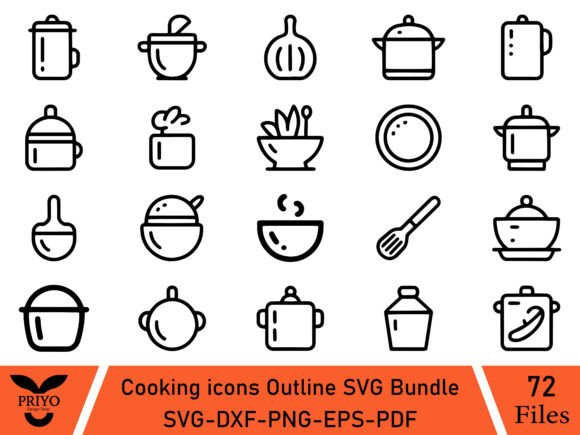
Cooking Icons Outline SVG Bundle
First Impressions: Clean, Friendly, and Purpose-Built
Opening the Cooking Icons Outline SVG Bundle feels like flipping through a well-organized sketchbook—no clutter, no overdesign, just confident line work. These aren’t fussy illustrations; they’re kitchen essentials drawn with intention: whisk, pot, spoon, oven mitt, chef’s hat, rolling pin, and more—all in crisp, continuous-outline style. The mood is warm but uncluttered—think modern farmhouse meets craft fair charm. As an embroidery designer who’s stitched hundreds of food-themed projects, I immediately recognized how this bundle avoids two common pitfalls: excessive detail that collapses under thread, and oversimplified shapes that look flat or generic. It lands right in the sweet spot—recognizable at small scale, expressive enough to carry personality, and built for translation into stitch.
A Real Project Test: Embroidering a Linen Kitchen Towel Set
Last week, I prepped a small batch of linen tea towels for a local boutique—custom embroidered with one icon per towel, meant as holiday hostess gifts. I chose the whisk and pot icons from the Cooking Icons Outline SVG Bundle. Why? Because their clean contours held up beautifully when converted to a single-layer running stitch (no fill, no satin), and their proportions scaled down to 2.5" without losing legibility. On textured linen, the outlines popped—not harshly, but with quiet confidence. Customers commented on how “hand-drawn” and “thoughtful” they looked—not machine-made, but *designed* for hand-feel. That’s the quiet strength of this bundle: it supports the handmade story, not competes with it.
Where It Shines in Real Embroidery Work
- Custom apparel: Works cleanly on cotton sweatshirts and structured tees—especially when used as a subtle chest accent or sleeve detail. The outlines don’t fight fabric drape.
- Tote bags & aprons: Holds clarity even on medium-weight canvas or duck cloth. No dense fill stitches means less bulk and better wash durability.
- Baby embroidery & nursery decor: Soft, rounded shapes (like the oven mitt or mixing bowl) read as gentle and age-appropriate—ideal for onesies, bibs, or pillow covers where minimal stitching is safest.
- Embroidered patches: Perfect base for iron-on or sew-on patches—clean edges mean crisp cut lines and stable backing.
- Holiday & wedding gifts: Paired with neutral thread (ecru, charcoal, sage), these icons feel elevated—not kitschy—making them ideal for personalized kitchen towels or monogrammed aprons.
- Etsy listings & digital product previews: The SVG format makes it easy to generate clean printable mockups. I dropped the pot icon into a flat-lay photo of ceramic mugs—looked instantly cohesive and brand-ready.
Where to Use It Thoughtfully
This isn’t a “set-and-forget” design. Its outline nature means success depends on context. Here’s what I watch for:
- Small hoop sizes (under 4”): Some icons—like the full chef’s hat with brim detail—need breathing room. Trim or simplify before scaling below 2”.
- Stretchy or thin fabrics: Avoid using dense satin-stitch conversions on knits or baby rib. Stick to running or stem stitch for stability.
- Dark or heavily textured fabrics: Light thread colors (ivory, pale yellow) may fade visually. Test contrast first—sometimes a single outline needs a tiny underlay stitch to lift off the surface.
- Curved surfaces (caps, curved pockets): The pot and spoon icons adapt well; the rolling pin’s long horizontal shape can distort if hooped too tightly. Reposition or break into segments if needed.
- Frequent-wash items (kitchen towels, baby clothes): Outline-only designs hold up better than dense fills—but always use quality polyester thread and appropriate stabilizer (tear-away for stable weaves, cut-away for knits).
How It Shapes Perception—and Sales
In my experience, customers don’t buy “an icon.” They buy *intention*. When someone sees a clean, balanced whisk outline on a linen towel, they read care, consistency, and attention to craft—not just decoration. That perception lifts perceived value: a $28 towel becomes a $38 gift. For Etsy sellers and small shop owners, that difference compounds across listings, branding, and repeat buyers. The Cooking Icons Outline SVG Bundle supports that quietly—it doesn’t shout, but it earns trust. And because it’s versatile across mediums (embroidery, print, sublimation), you’re not locking yourself into one product type. One icon can anchor your embroidered patch line *and* your printable kitchen planner collection.
Practical Designer Notes Before You Stitch
- Always test the Cooking Icons Outline SVG Bundle on scrap fabric matching your final project—linen behaves differently than cotton poplin, which behaves differently than fleece.
- Check thread color contrast against both light and dark backgrounds. A soft gray works on white but disappears on navy—try charcoal or deep olive instead.
- Review stitch density in your embroidery software. Outline designs should run between 0.8–1.2 mm stitch length—anything tighter risks thread breaks; looser loses definition.
- Confirm hoop size compatibility. If your machine’s smallest hoop is 4x4”, some icons may need repositioning or slight resizing.
- Inspect corners and tight curves—some vector points translate poorly to stitch paths. Smooth minor kinks in your digitizing software before embroidering.
- Test black-and-white mockups. If it reads clearly without color, it’ll translate well across fabric types and lighting conditions.
- Use proper stabilizer—never skip it, even on stable wovens. A lightweight tear-away prevents puckering and keeps outlines crisp.
- Verify licensing terms. Since this is listed as a Graphics product in the Illustrations category, confirm whether commercial use (selling finished embroidered goods or digital assets) is permitted before listing on Etsy or wholesale platforms.
The Cooking Icons Outline SVG Bundle won’t replace every food-themed design in your library—but it fills a specific, valuable gap: the need for warm, scalable, stitch-smart icons that honor the handmade without demanding perfection. It’s the kind of asset that makes clients say, “I love how simple but special this feels.” And in a crowded craft market, that feeling is worth more than any extra flourish.