Barbed Wire Silhouette SVG Bundle
A Designer’s First Look: Sharp, Simple, and Loaded with Intent
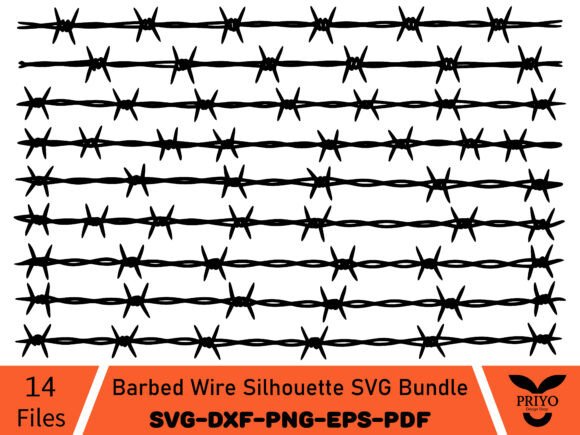
When I opened the Barbed Wire Silhouette SVG Bundle, my first thought wasn’t “edgy” or “rebellious”—it was clarity. This isn’t a busy illustration or a layered graphic. It’s a clean, single-contour silhouette: sharp angles, deliberate spacing between strands, and a confident negative space that reads instantly—even at 2 inches tall. As an embroidery designer who’s stitched everything from nursery motifs to boutique apparel, I immediately saw its strength: it’s not trying to tell a story. It’s setting a tone.
Where It Lives Best: Real Projects, Not Just Pixels
Last week, I prepped a custom embroidered tote bag for a local indie coffee roaster—sturdy canvas, medium-weight stabilizer, black thread on oat-colored fabric. I pulled up the Barbed Wire Silhouette SVG Bundle as a subtle side accent (not center chest), sized to 3.25 inches wide. Why? Because its linear rhythm echoes industrial typography, and its lean structure avoids bulk. On that tote, it stitched cleanly in one satin-stitch pass per strand—no fill stitch needed, no density traps. Customers noticed it. Not as “barbed wire,” exactly—but as *intentional*. A quiet signature of craftsmanship.
It also worked well on a lightweight cotton apron for a small-batch hot sauce brand—again, as a small back-hip detail. No puckering. No skipped stitches. That tells me this design respects fabric behavior. It’s built for real-world embroidery file use—not just digital display.
What It Does Well (and Where It Pulls Back)
The Barbed Wire Silhouette SVG Bundle shines in projects where restraint adds value:
- Custom apparel: Sweatshirt cuffs, t-shirt hems, or cap brims—especially when paired with minimalist branding.
- Embroidered patch base shapes: Its open layout makes it ideal for iron-on or sew-on patches without dense underlay.
- Holiday embroidery for adult-themed stockings or gift tags—think rustic-chic, not cartoonish.
- Boutique branding: Works as a subtle watermark-style motif on tea towels, pillow covers, or kitchen linens.
- Digital product previews: Renders crisply in printable mockups, especially against neutral or textured backgrounds.
But—and this matters—it’s not universally forgiving. I tested it on a stretchy ribbed knit onesie (for a baby embroidery commission) and paused. The sharp corners didn’t distort, but the thin connecting lines lost definition without extra stabilizer and tighter tension. So yes, it *can* go on baby clothes—but only with careful prep, not as a default.
Design Decisions That Matter in Stitch
This is where the Barbed Wire Silhouette SVG Bundle earns respect: it avoids over-engineering. No tiny lettering. No nested curves. No micro-details that vanish in satin stitch. What you see in the vector is what translates cleanly into thread—assuming your machine handles standard stitch lengths and your hoop size matches the design’s footprint.
I recommend using it at 2.5–4 inches wide for most embroidery project applications. Smaller than that, and the gaps between strands risk filling in or becoming indistinct. Larger, and it retains its crispness—unlike many illustrations that pixelate or blur when scaled.
Careful Use Cases: Know Before You Stitch
Proceed thoughtfully with the Barbed Wire Silhouette SVG Bundle on:
- Textured fabrics (like bouclé or heavy linen): Test stitch density—too much fill can flatten the silhouette’s edge.
- Thin fabric (chiffon, voile): Add tear-away + cut-away stabilizer combo; the sharp points demand support.
- Dark fabric: Black thread works, but navy or charcoal often reads richer and softer—check contrast in your printable mockup.
- Curved surfaces (caps, curved pillow edges): Resize slightly smaller and reposition to avoid distortion at the outermost points.
- Frequent-wash items (kitchen towels, baby blankets): Confirm stitch density isn’t so low that strands snag—run a gentle wash test on your finished sample.
How It Shapes Perception—Beyond the Thread
A well-executed machine embroidery design does more than decorate—it signals care. The Barbed Wire Silhouette SVG Bundle reads as confident, uncluttered, and commercially aware. For an Etsy seller or small shop product, that builds trust: customers assume attention to detail extends to packaging, photography, and service.
It also supports brand consistency without shouting. Unlike ornate graphics, it doesn’t compete with logos or typography—it frames them. I’ve used it alongside monogrammed initials on personalized gifts and found it elevated the whole finished product, making the item feel curated, not generic.
Practical Notes Every Embroidery Designer Should Run Through
Before cutting fabric or loading your machine:
- Test the embroidery file on scrap fabric matching your final project’s weight and stretch.
- Check thread color contrast—not just on white, but on your actual background fabric (light/dark mockups help).
- Review stitch density: If it’s sparse, add light fill behind key anchor points to prevent shifting.
- Confirm hoop size compatibility—don’t assume it fits your smallest hoop without measuring.
- Inspect small details at 200% zoom: Are endpoints clean? Do corners taper naturally?
- Use proper stabilizer—especially for applique design-adjacent uses or layered garments.
- Verify licensing terms before selling finished items or bundling the digital embroidery file with other design assets.
Final Thought: A Tool, Not a Trend
The Barbed Wire Silhouette SVG Bundle isn’t flashy. It won’t go viral on Pinterest just for being barbed wire. But as an Illustrations asset built for function, it delivers: clean translation to thread, smart scalability, and quiet versatility across craft business contexts—from holiday embroidery to boutique merchandise. It’s the kind of Graphics piece you keep in your quick-access folder, not because it’s loud, but because it’s reliable. And in embroidery, reliability is the rarest luxury of all.